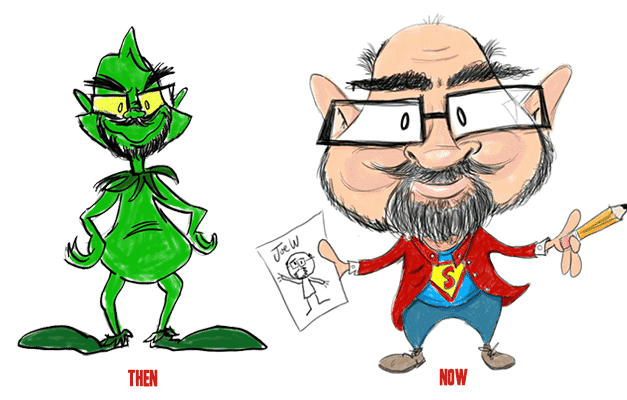
When I told, cartoonist Joe Wos that I felt his transformation was incredibly comparable to the 1966 version of the Grinch, he not only agreed, but he drew himself as the Grinch for us. “Totally. It’s a story of redemption,” he said. Indeed it is. Illustrations by Joe Wos.
Storytelling is the best medicine
Resistance to bike infrastructure improvements and bike culture or “bikelash” is nothing new, furthermore many consider it to be a sign of progress.
In the past few years Pittsburgh has made many important advancements that have increased comfort and accessibility for bikers across the city. And in the past few months with Mayor Peduto’s leadership we’ve seen unprecedented commitment to making biking in Pittsburgh safe and enjoyable. So the fact that local cartoonist, Joe Wos, is now known in Pittsburgh’s bike community for having openly shared his hostility towards the recent bike infrastructure improvements – bike lanes and bike racks alike – shouldn’t come as a surprise. His recent op-ed in the Post-Gazette jumbled together dozens of inaccuracies about people who bike in Pittsburgh, most of which we’d heard before.
But then something important and relatively unusual happened: he changed his mind. Or, rather, you changed his mind. Joe heard from you — the diverse, committed community of Pittsburgh bike riders and supporters. And from hearing your experiences he learned that he had made some seriously off-base assumptions about people who ride bikes.
So as we continue to work together to make Pittsburgh’s streets safer for people to bike and walk, be sure to share your story. There are as many reasons for biking as there are people who bike, and our reasons change from day to day and year to year. Let’s make a commitment to share the reasons why we bike by talking to the people who surround us and by using #WhyIBike on social media. Let’s keep up the conversation.
Below are Joe’s sincere, unedited responses to our questions. Joe, we’re mighty glad that you have come around.
1./ Tell us your age, where you live, and where you work or your profession.
I am 44 years old. I currently live in Penn Hills, PA, but I grew up in Braddock. I am a freelance cartoonist, writer, and storyteller. I am also the former founder and executive director of the ToonSeum.
2./ Was there a particular event or experience that lead you to write your Enough about the bikes, bikes, bikes op-ed?
There were actually a couple of experience that all seemed to culminate in writing that piece. First, at the time I was working downtown at the ToonSeum. Which is on the 900 block of liberty avenue. The block is still reeling from the August Wilson Center Debacle. So there were frequent conversations with other businesses about how to improve the area, and what is helping and hurting that part of town. Bike lanes were viewed with a lot of resentment, there are so many other things that needed addressed. When bike lanes began getting all the hype, a lot of us reacted the same way: “This is their solution?” The zealous efforts to promote and “sell” the concept of bike lanes and all their benefits came off as claims of it being the great solution. So I had all that floating around in my head. Then one afternoon I was walking downtown around noon. A guy on a bike rode off the street and onto the sidewalk and started screaming at me “on your left!” I turned around to see who was yelling. “He then sped past me on the sidewalk and shouted “move it a-hole!” He then got off the sidewalk into the street and ran a redlight! Lol I couldn’t believe it. I was fuming at the sheer gall and disrespect from this particular bicyclist. I started paying attention to bikes and how they were interacting in the city. What I saw (and likely it was because it was what I was looking for) was a lot of disregard for traffic laws, mostly running red lights, and hopping on and off sidewalks. And then…. The city and Cultural Trust held a press conference for the installation of bike racks. The whole thing took on a surreal quality of being an article written about Portland in the Onion.
So dealing with a few bad bicyclist and the hype built up a lot of resentment!
3./ How would you characterize your feeling towards bikes in Pittsburgh and people who ride them at the time when you wrote the op-ed?
At that time I viewed bicyclist as militant vegans who were going to force you to listen to their poems about trees while shoving tofu into your face. I associated bicyclist with elitist. Again a few experiences can completely cloud your opinions if you don’t seek out other opportunities.
I really viewed them as constantly shouting to the city “You’re fat! Get a bike! You’re polluting the earth! Get a bike! You’re stupid! Get a bike!” I absolutely viewed them as hating anyone who didn’t adopt their lifestyle and as a judgemental and preachy lot.
I saw many bicyclist as blindly overzealous followers of a religion that didn’t just want religious freedom, they wanted everyone to convert!
I have three kids, I wasn’t going to drive three kids to softball practice on a bike! It was a feeling of being judged without any regard to the practical issues of individual situations.
I also viewed them as hypocrites when I found out the over 90 percent of bicyclist own cars. By the time I wrote the article I was anxious to deflate what I regarded as the most overhyped pretentious thing in Pittsburgh since the big rubber duck! I attacked it from every possible angle and found studies and facts to back up everything I wanted to say. That’s one thing about studies for every study there is an equal but opposite study.
4./ What caused you to change your position on bikes and biking in Pittsburgh?
After the article ran I followed the reaction on twitter, facebook and my personal email. At first I got a lot of name calling “hey fatty you need to ride a bike.” I also got a few threats, which was a little scary, but at first it all reinforced my opinions on bikes.
But then something else happened. I began to hear from real people. They were taking the time to send links to studies. Then they began to say- “here’s why I ride a bike.” Not bikes are saving the world! But “biking is important to me.” They shared their passion for biking not in a way to convert but in a way to educate and help me understand.
With that came personal stories of the risk and dangers they faced everyday. The turning point was when it ceased to be about bike lanes and became about bicyclist, about people. It became less of a political issue about a bunch of marked pavement and became about the people who ride bikes. I was appalled that my article was being used to advocate an attitude of putting bicyclist in harms way. I was just as affected by anti-bicylist comments and their rage filled hatred.
I realized I was creating dialogue or discussion, I had only turned up the heat on a boiling situation. As all that is happening I am still getting informative and even compassionate emails from bicyclist friends “saying, I understand the points you were trying to make, but some of it, not all, but some of it was misinformed.” They helped guide me on a bike path to enlightenment!
I began to realize it wasn’t about the paths, or the percentage of bicyclist, it was about individuals. If a bike path cost a half million dollars but it saved one single life. Than it was worth every single penny and so much more.
I saw my daughter outside riding her bike and thought about what I would want for her. I ultimately want her to be safe. Shouldn’t everyone feel safe?
That was it. I was now informed, and more important connected to the human beings on those machines. I saw the humanity.
Once I got to that point, I started reading study after study and watched each of my arguments completely fall apart. I was wrong. Every single thing I wrote was wrong. The only single thing I could still stand by was that I felt bikes were being overhyped. But even that I understood as someone who also held passions and a constant pursuit of publicity for my equally underappreciated artform.
5./ Can you give an example of something meaningful that someone shared about biking or being a biker that resonated with you personally?
When I heard from women bicyclist that had the strongest impact. Women’s equality has always been important to me. I went to a primarily women’s college (Carlow), I actively promote women artists, and most important I have two daughters. What I was hearing from those female bicyclists was “this isn’t just about a bunch of white men with 5000 dollar bikes.” What I heard in my head was that my entire argument about this being an activity for a tiny minority group was prejudiced and close-minded. My god! Would I say we shouldn’t fund things for women or girls safety just because they are a minority group? Of course I wouldn’t! Every woman who messaged me “I bike, and I’m scared that I’ll get hit by a distracted motorist” sent me deeper into regret over what I had written and believed.
My argument about bikes being exclusionary of minorities really haunted me. It was such a cheap shot at a group that have been working hard to reach out to minority groups.
As I began to hear from more and more women and minority bicyclist I grew disgusted at my own piece I had written. I couldn’t distance myself from it, but I could learn from it.
I also looked to people I deeply respect such as councilman Dan Gilman. If someone with such a strong commitment to this city thinks that bike paths can help, than there must be something to it!
6./ How do you now feel about bikes in Pittsburgh and what might you have learned about people who ride them?
I respect them. Especially their passion and commitment, to not just biking, but to improving our city. What I considered misguided blind hype is actually sincere concern and enthusiasm.
They are a bunch of geeks and there is no one I respect more than a geek! I now am hyperaware of them when I drive. I am concerned for their safety as individuals. I recognize the real and tangible benefits of not just biking, but of bike lanes for us all as a city.
If you can improve any aspect of this city for any of its citizens than we are all better for it and we all benefit.
They are people not bikes. That is what I needed to learn. That we aren’t talking about bike lanes we are talking about people lanes. People who happen to be on bikes because they are concerned and want to make Pittsburgh a better place, and this is their way of making a difference.
7./ Any advice for the bike community? How can we better explain the importance of creating safe streets for all road users — pedestrians, bicyclists, and motorists alike?
Stop talking about bike paths and start talking about people who ride bikes! This has become a political issue about pavement and not one about human beings. That is what is lacking in the conversation on both sides. Help take some of the animosity out of this. There are people in those cars and people on those bikes. Lets talk about relationships. Especially the relationships of motorist and bicyclist sharing the road. There also needs to be education not just of motorist but of bicyclists. We all have a lot to learn about each other. In order for bicyclist to be more widely accepted they need to also accept motorist. Sharing the road goes both ways and we all need to start respecting each other.
Focus on trying to sway individuals not change an entire city all at once. When you force change it feeds animosity and fear, but if each bicyclist offered to go out for a ride with a friend and introduce them to bicycling, then you can change those attitudes.
Focus on immediate and tangible benefits for individuals. Share why you ride a bike, not why everyone else should ride a bike. When they hear your story, and how it benefits you they will take that to heart and see if they can apply to their own lives. We take up new habits by observing them in others and seeing the benefits first hand.
It all comes down to “respect.”
Respect the laws. Respect bicyclist safety and rights. Respect the road.. but most important of all respect one another.
8./ Anything to add?
Share you stories, share your experiences, and lets all share the roads.
So what’s your story? We’d like to hear why you bike.
 NEWSLETTER