Even in record-breaking heat, 13,000 people showed up for OpenStreetsPGH. What does that tell us about public space, rest, and who our streets are built for?
By BikePGH staff contributor, Christine Yockel
TL;DR creating public space for resting, relaxing, and existing, makes people want to be in that space and benefits all road and sidewalk users from an economic, health, and quality of life standpoint.
The final OpenStreetsPGH of the 2025 BikePGH summer events season was Sunday, July 27th. It was 86*F (nearly 10* above the average temperature of 77*) with 96% humidity. According to the National Weather Service Heat Index Calculator, that math means the “feels like” temperature was 109*F, in an area largely covered by asphalt and concrete.
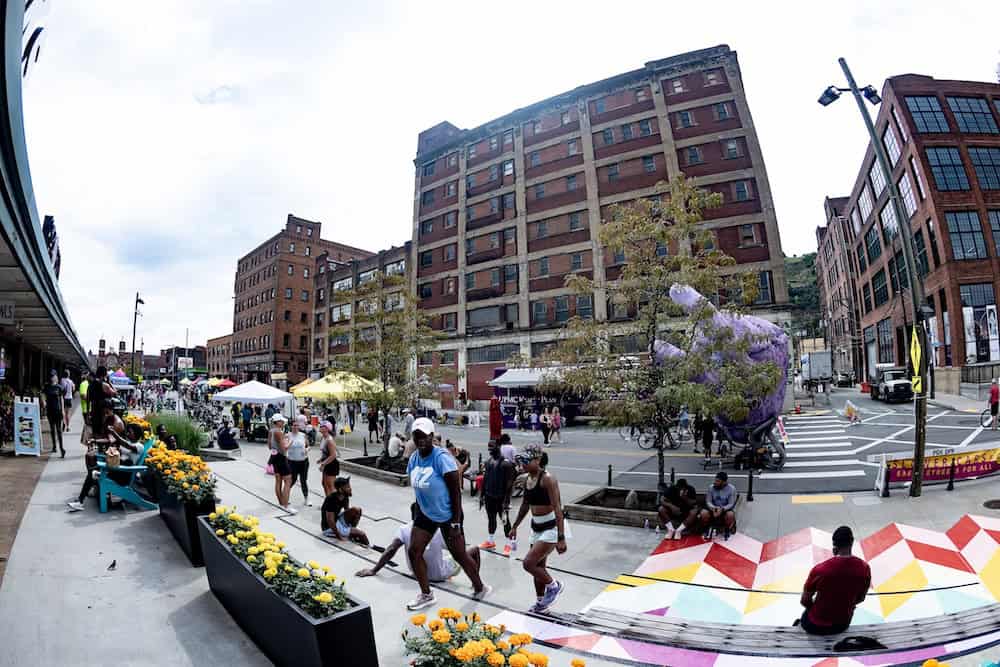
And 13,000 people still came out and rode bikes and roller skated and skate boarded and danced and rolled their wheelchairs up and down 3.6 miles of car-free Pittsburgh streets. I, myself, survived by drinking what seemed to be 12 gallons of water and taking frequent, seated breaks in the shade and so did, it seemed, many other attendees. I saw folks seated on stoops and alcoves of buildings, I saw them on the colorful steps of the Strip District Terminal, on the handful of benches, even seated right on the sidewalk, their backs against a building, or on the curb, feet in the street.
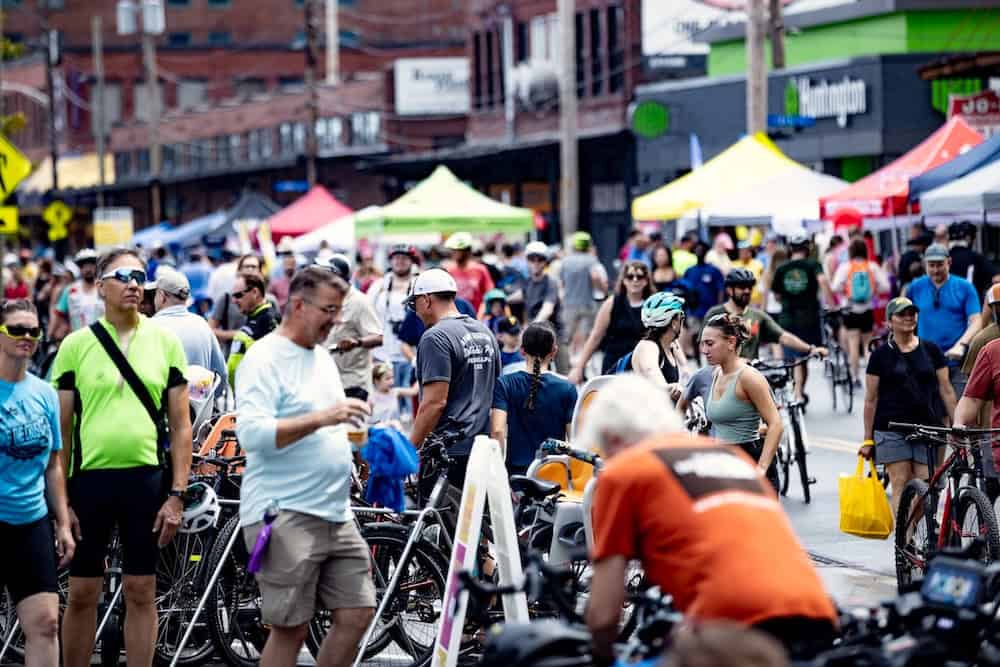
Aside from our event staff, the majority of event attendees did not have to be there. They made the choice because they know OpenStreetsPGH is a good time. And there were smiles on every face I could see.
What does this tell us? That people want to be in spaces designed with them in mind. And creating physically safe spaces for their bodies to move (and rest!) is a huge part of creating hospitable, enjoyable spaces.
When you make spaces hostile for some of us, you make them hostile for ALL of us
Last spring, I was meeting friends for dinner in Downtown Pittsburgh. It was a Sunday, so the bus service was limited (INVEST IN PUBLIC TRANSIT!) so I took a bus that ended up getting me there an hour earlier than I was planning to connect. I had the notion that I could just find a coffee shop and read a while until it was time to meet. But all the coffee shops closed by 3pm (and some weren’t open at all on Sundays), the seats in Market Square weren’t yet out for the season, and so I ended up walking 4 blocks in the opposite direction to PNC Tower before I found somewhere to sit and read my book — their planters next to a bus stop.
I have to wonder whether my struggle to find seating was from the intentional removal of places to rest, to discourage “loitering” or “camping”. When you make spaces hostile for some of us, you make them hostile for all of us… And, seriously folks, we have to do better (perhaps we’ll go down that troubling rabbit hole in a future blog)…
Let’s go back to a time in my past where I was physically limited. I have been pregnant twice, and while I remained more or less mobile both times, I was noticeably restricted in range and ardour. I took frequent breaks from fatiguing easily and, well, cramps in places I had never experienced before. And I often had to take my stops and starts while standing or leaning against a wall, because wherever I was never seemed to have a place to sit that I could then reliably stand back up from.. (or public bathrooms! But that’s also for another time).
What do the “experts” say?
There are plenty of Landscape Architect and Urban Planning firms that can demonstrate the breadth and variety of seating choices available. The Social Life Project’s article titled “How Seating Shapes Welcoming Cities” does a great job of quickly demonstrating what does and doesn’t make a good seat. And this Strong Town’s article “The Secret to a Better City? More Places To Sit makes a good case for the economic benefits as well as social aspects of thinking about third places for folks to congregate and exist.
But we don’t need studies to tell us that having places to rest in public makes life better– because we can feel it.

And because we can feel it, it shouldn’t be a surprise that shade makes the heat more bearable and that the overlap of neighborhoods that are historically underresourced have less seating, less shade, and in our ever-warming world, are less safe to live in as a result.
Here, in more scientific demonstrations, is an overlay of asphalt to tree canopy cover as it relates to heat retention. And here, for comparison, is an overlay where one can dig deeper and see all of that with the added context of historically redlined areas, canopy cover, and relative heat compared to the city average.
Public spaces should first be centering the needs of our most vulnerable road users
When 13,000 people show up to OpenStreetsPGH on a super hot Sunday afternoon to hang out and connect with their neighbors, it’s clear that they crave public spaces where they are safe and welcome.
And, we deserve infrastructure that considers shade, seating, and access as essential, not optional. Our public spaces should first be centering the needs of our city’s most vulnerable road users, like pregnant people, disabled folks, and older adults, and we need to be designing our cities where everyone, regardless of ability, age, income, or identity, feels safe and comfortable whether traveling from Point A to Point B, or simply just relaxing and existing. No matter what the weather pattern, public space should be WELCOMING us all, not pushing us out.
What can you do right now?
- Pittsburghers for Public Transit is doing a bus shelter audit. You can fill out this form and record bus stops in your neighborhood or along your commute that are missing things like shelters, seats, trash cans, and signage, like these:

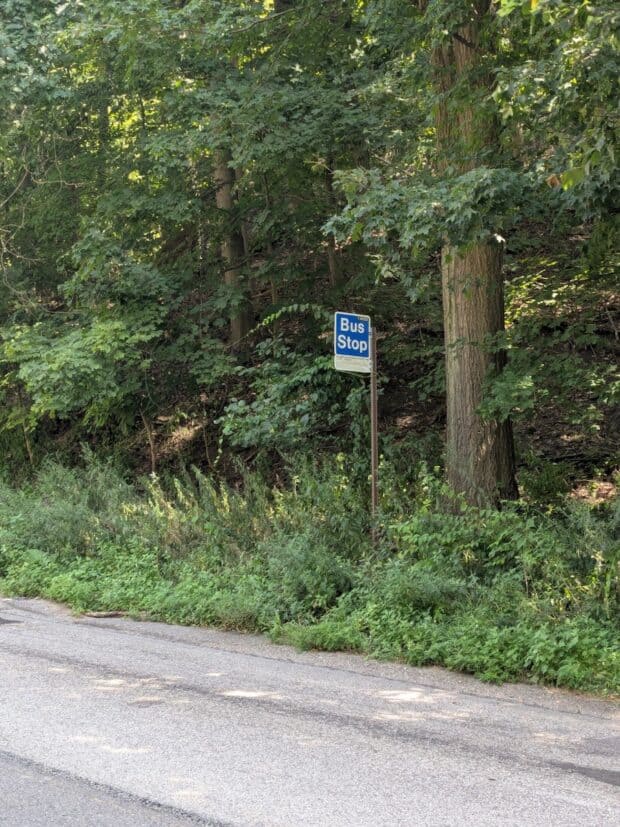
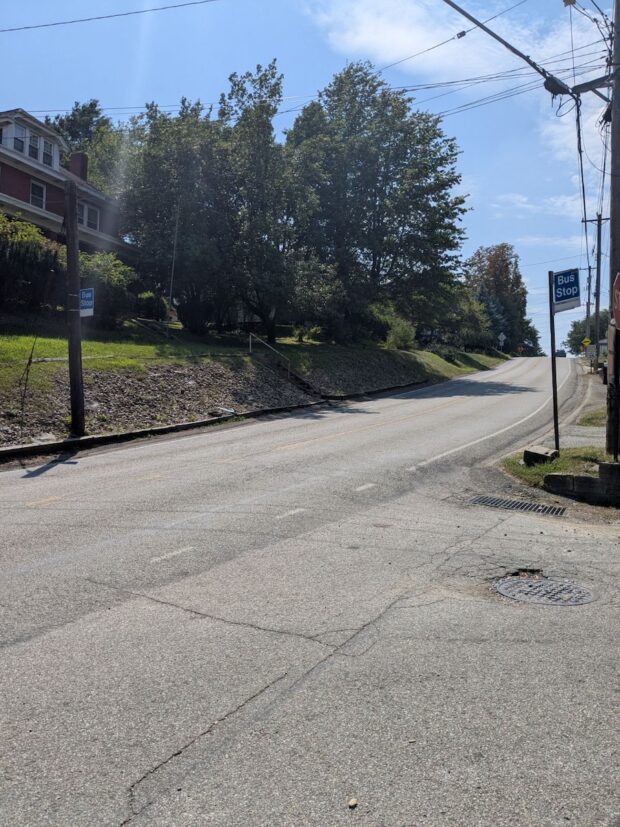
Above are examples of unwelcoming bus stops on Seavey Rd in Pittsburgh. Would you want to walk and wait for the bus here? Probably not, because these areas are clearly dangerous and unaccessible.
- Reach out to your elected officials, your neighborhood RCO or CDC. See if you can officially or unofficially host a sidewalk audit.
- Reference AARP’s walk audit toolkit and put a special focus on tree shade, places to sit, and parklets.
- Go rogue! Create some “desire seats” where you’d like to see seating. Encourage folks to use them. Put a sign up that says “wouldn’t it be cool if this was a real bench?”. Tactical Urbanism creates spaces for people using low cost materials from the bottom up, allowing citizens to inspire the design process. Just be sure to respect ADA accessibility with your placement!
 NEWSLETTER