Let’s have an honest discussion about what’s going on
When we launched our Safe Trips in the Strip Campaign, we were under no illusion that it would be easy to push for the safety of all road users. Change is hard, but we admittedly thought that a sober engagement with facts, backed by an abundance of studies, and mixed with a robust engagement with business owners and residents would lead to good faith conversations to get something done.
Given our history of pushing to change our streets, we’ve come to understand that the projects that make significant changes a) will not please everybody (including bicyclists), and b) that a project opponent’s doom and gloom predictions of a given project never comes true.
Any time you change something, there are tradeoffs to be made. For instance, installing a protected bike lane may mean that the most confident riders likely won’t be able to ride as hard as they once did along a given street, but the tradeoff of more people cycling more safely is worthwhile.
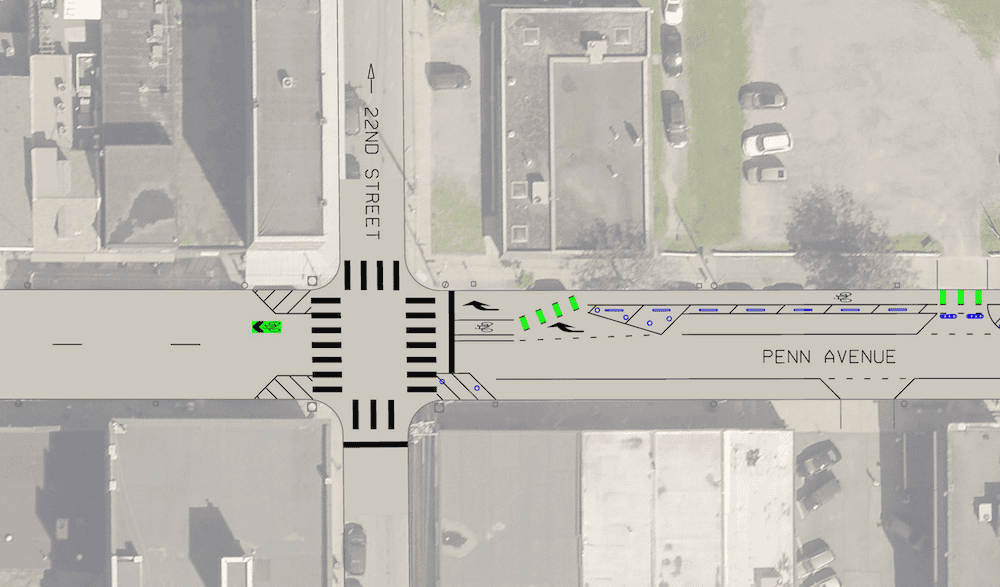
The same goes for drivers. On the proposed Penn Ave Rightsizing Project, for instance, continuing the single, inbound motor vehicle lane another nine blocks seems like a worthwhile tradeoff to combat the serious safety issues that the current configuration creates. Sure, drivers won’t be able to speed down Penn Ave, but the improvements for pedestrians, bicyclists, and law abiding drivers seem worth it. Slowing cars down to the speed limit has the added advantage of allowing drivers to actually see what businesses are offering along the way.
However, the thing that has surprised us is the amount and level of hyperbole and misinformation that is coming from some people opposed to the project. While people are entitled to their opinion on a given change, they are not so entitled to spread false, misleading or incorrect information. Some of this misinformation is easy to rebut. For instance, it doesn’t take long to see that the project does not affect the “heart” of the Strip between 22nd and 16th, however saying it does has become a talking point spread by some opposed to the project. A recent article in the Pittsburgh City Paper, as well as a conversation on City Cast Pittsburgh both do a good job countering some of the other claims.
Unfortunately, some of this misinformation has made its way to a lawsuit and injunction against the project, and these points are less easy to counter.
Here’s an attempt to understand what’s going on with the four main complaints in the lawsuit opposed to the Penn Ave Rightsizing Project in the hopes of being able to have some good faith conversations around the safety problems endemic to the street.
1. Violation of Adopted Fire Safety Standards (IFC § 503.2.1)
Arbitrary and Capricious Definition: A decision that is made without reasonable justification, proper consideration of facts, or a rational basis, and is instead based on random choice, whim, or impulsive action.
Our understanding of the fire code is that it is intended for and applies to developers, and does not apply to city-owned streets managed by the city. If this line of code does indeed apply to the city, then we actually have a huge problem on our hands because a significant number of existing streets do not comply with the 20’ clearance width rule. If this rule were true, then we’d have to get rid of parking on many of our streets, as over a third of Pittsburgh roadways leave less than 20’ of clearance, including each of the roads surrounding the Pittsburgh Fire Union building in Hazelwood. As far as we know, this rule has never been cited before, and surely hasn’t been enforced.
Basically, we can’t pick and choose when to use a rule or not.
2. Unlawful/Ultra Vires Action Under Pennsylvania Traffic Law (Parking Protected Bike Lane Implementation)
It is true that, according to a technical reading of the Pennsylvania Vehicle Code that requires cars to be parked 12″ from a curb, that parking protected bike lanes may not comply. We’ve written extensively about this, and our attempts to change the Vehicle Code.
PennDOT, for instance, won’t allow these types of bike lanes on state-owned roads, and won’t fund these types of bike lanes with state money until this technicality is changed, or it’s part of a pilot project. However, local municipalities do have some flexibility when it comes to their own streets, and have an ability to use standards from roadway design guides that they have approved.
This stretch of Penn Ave is owned by the city and they are using city funds to install the Parking Protected Bike Lanes – something that they have been doing on city-owned streets for over 10 years, starting on Schenley Dr in Oakland. The most recent parking protected bike lane just opened for business this month on Terrace St, also in Oakland.
3. Public Nuisance /Threat to Public Safety and Commerce
According to the complaint, “proceeding with the project as designed will substantially and unreasonably interfere with public rights to safe passage, emergency access, and ordinary business operations, causing irreparable harm to Plaintiffs and the public.”
This is misleading.
The lawsuit cites an April 11 letter from Ralph Sicuro, the president of the Pittsburgh Fire Fighters Union, who says “if the Penn Avenue Project proceeds as currently designed, it will directly violate this critical code requirement.” The City responded to this letter, and went on to create a compromise design that increased the motor-vehicle lane to allow for fire trucks to deploy their full equipment, while decreasing the width of the bike lane.
In short, Mr. Sicuro had concerns with how the bike lane was “currently designed” as of April 11, but DOMI has since reached an agreed upon width with the Department of Public Safety that is different from when Mr. Sicuro originally wrote in his letter.
As currently designed, Penn Ave has an extremely high crash rate for the level of traffic that it sees. This is due, in part, to there being two lanes that allow drivers to speed. The out of date loading zones encourage blocking an active lane, which only amplifies the erratic driving behavior. Smallman St, with a single lane in each direction, sees more vehicles per day, with a fraction of the crashes. Why? It’s harder to speed.
Through multiple rounds of public feedback and reviewing crash and traffic data, the City has refined the scope of this project to ensure the safety and operations for all road users – including emergency vehicles.
4. Failure to Provide Required Notice and Hearing/Violation of Procedural Due Process
It’s hard to believe that there was not enough notice around this project, considering an opposition campaign that included billboards, a website, and printed materials. There have been countless articles about the project. This project has had an Engage Page for over a year, and included a very well attended public meeting, and multiple neighborhood-level meetings with the business and neighborhood groups. Since announced, the City has been meeting with affected businesses to update their loading zones to better match current needs.
What can we agree on?
It’s clear that we all love the Strip District and want it to succeed. Many locals from the surrounding neighborhoods depend on getting to and through the Strip for their job or for basic needs. Safety is so important to so many Pittsburghers that it’s a moral imperative to address known, dangerous conditions with tried and true designs. Residents also want access, without needing a car, to the variety of fresh food that the Strip has to offer. The Penn Ave Rightsizing project is an attempt to address these issues, so let’s please have an honest conversation about how to do so and make Pittsburgh a better place to live.
As of writing, milling and paving has begun on Penn Ave. We’ll find out soon what happens from here, so stay tuned to our social media and blog.
 NEWSLETTER
1 Comment
I commute along this corridor twice a week between garfield and downtown. I am nearly struck or passed in an unsafe manner by speeding and careless drivers almost every time, often multiple times per commute. This protected bike lane will significantly improve my and other cyclists’ safety. I wish it connected all the way through 16th street. As a result of their callous and counterfactual opposition, I will not patronize the businesses who have objected to the bike lane, and I will discourage everyone I know from doing so. The perceived potential loss of business, real or otherwise, does not outweigh the physical safety of pedestrians and cyclists in the strip district. The next time a cyclist or pedestrian is struck on Penn avenue, their blood will be on the hands of those businesses.