
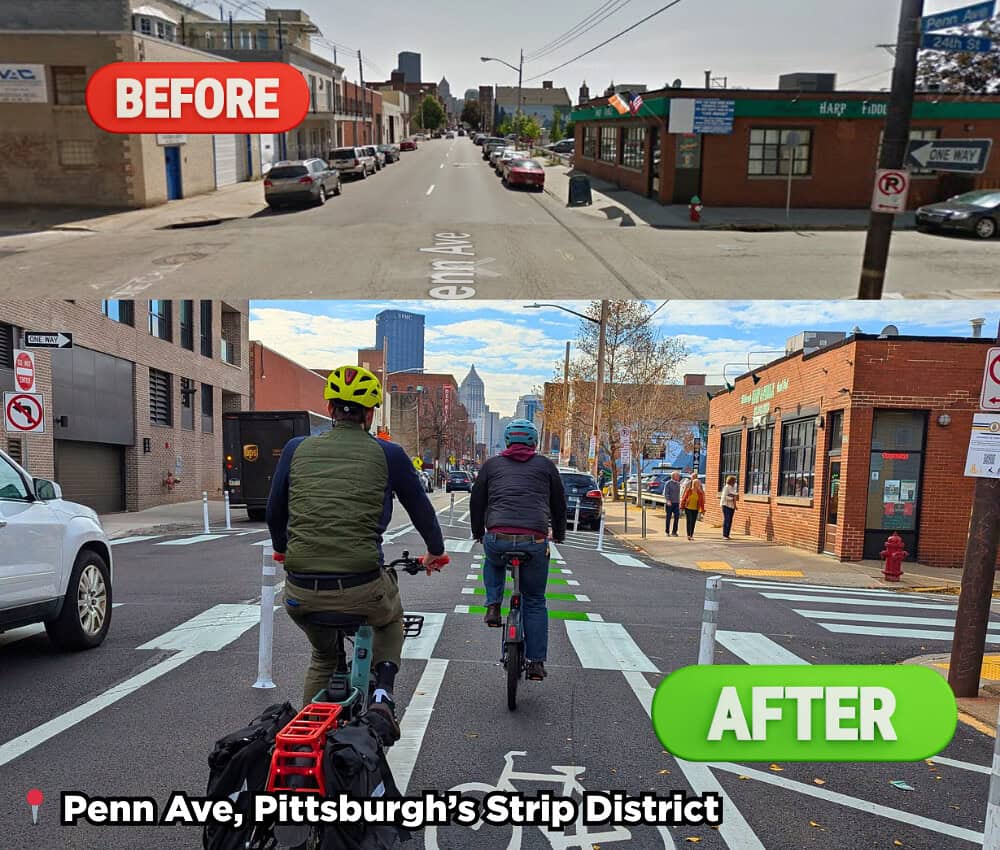
After a long, drawn out process, the Penn Ave bike lanes in the Strip District are done
As many of our readers know, we’ve long been pushing for Safe Trips in the Strip, and this project goes a long way to make that a reality.
Everyone who travels to or through the Strip should be able to do so safely and easily, however, the neighborhood is a highly-trafficked and confusing area to navigate, with a high crash history to prove it. Thousands of people have recently moved to the Strip, with more to come, making it the fastest growing neighborhood in Pittsburgh. If people don’t have an alternative to driving, then traffic and parking will become much worse while walking and biking becomes less safe. With 14 lanes of traffic dedicated to moving or parking cars, the City proposed extending the single inbound lane on Penn Ave for another nine blocks to 22nd St, while creating a bike lane to make it safer and slow cars down.
These new bike lanes to and through the neighborhood will help bike riding residents access the numerous jobs, fresh food and entertainment options along the corridor, and reduce the number of cars using Penn Ave as a cut through. In addition to slowing cars down to the speed limit, the bump outs at each intersection make it easier for pedestrians to been seen and cross the street. Additionally, the project also includes numerous new loading zones for Strip District businesses. However, the metered parking and enforcement between 25th and 31st St has not yet been implemented, which will free up even more parking for customers and deliveries.
Please keep in mind that any change to the built environment will take time to work itself out, as the city makes adjustments and drivers change their habits.
In the meantime, go out and enjoy the new bike lanes and be sure to stop and support some Strip District businesses while you’re there!
Design Changes due to bike lash – what happened?
The bike lane from 31st St to 22nd St, a key part of the overall Penn Ave Rightsizing safety project, has changed dramatically since it was first proposed as a parking protected bike lane in 2024. The Strip District Business Association, before giving the City a chance to work out a design, immediately opposed the project and ended up suing the city over this design. They had four complaints, and a judge helped arbitrate the disagreement with the City. The judge threw out two of these complaints, but had concerns about the other two, reviewed below.
1. Parking Protected Bike Lanes – This common bike lane design is not allowed on Pennsylvania-owned roads due to a technicality in the Motor Vehicle Code, something we’ve been fighting to change for a number of years. So far, we’ve been unsuccessfully able to change this law for over five years now, despite getting bills through the PA House unanimously multiple times. However, even with this technicality, the City has the flexibility to build this type of bike lane on their own streets, which they have done in many locations, but the judge said that there may be merit to the complaints.
2. Fire code – Arbitrary and Capricious Definition: A decision that is made without reasonable justification, proper consideration of facts, or a rational basis, and is instead based on random choice, whim, or impulsive action.
Our understanding of the fire code is that it is intended for and applies to developers, and does not apply to city-owned streets managed by the city. If this line of code does indeed apply to the city, then we actually have a huge problem on our hands because a significant number of existing streets do not comply with the 20’ clearance width rule. If this rule were true, then we’d have to get rid of parking on many of our streets, as over a third of Pittsburgh roadways leave less than 20’ of clearance, including each of the roads surrounding the Pittsburgh Fire Union building in Hazelwood. As far as we know, this rule has never been cited before, and surely hasn’t been enforced.
Basically, we can’t pick and choose when to use a rule or not.
Long story short, it put the city in a position where they would need to either see how these complaints play out in court, or install something now that addresses these complaints. A decision in court may not come for who knows how long, maybe years. Additionally, DOMI really needed to install the project before it got too cold because street paint needs to be applied at a minimum temperature.
Thankfully, DOMI had a backup design which diffused the two remaining complaints of the businesses. The city decided to move forward with the backup design, and the business group said they’d back off a bit, at least for now.
The back up design ended up being a more standard buffered bike lane, with bollards near the intersections to prevent drivers from using the bike lane to pass. Here’s our statement on the final design.
Pittsburgh doesn’t become a safer and more connected city by accident...

When people like you step up, you make progress possible. It takes every single one of us to complete the picture as we launch our 2025 Year-End Campaign to raise $100,000 by December 31st:
 NEWSLETTER