
Even though we have “bike” in our name, we also advocate for the rights of people who walk, including our neighbors who use mobility devices
Our overall mission goes way beyond just bikes, or what one disgruntled internet-user called “the niche minority interests of the big bike lobby”. If you think bike lanes are made for the sole benefit of the “avid cyclist,” we’re here to explain why this notion is just plain inaccurate.
BikePGH’s efforts to keep streets and roadways safer are very much shared across many communities and sectors
We believe a truly livable city is one where everyone has convenient and affordable options for getting around safely and reliably, no matter their age, income, ability, race, gender, or neighborhood. This is all a part of a bigger vision for a sustainable transportation network that works for everyone. Especially considering about a quarter of all Pittsburgh households do not have access to a personal vehicle, it is imperative that we have reasonable alternatives to driving such as connected bike lanes, good public transit, and safe sidewalks, so that all residents can access basic needs like jobs, doctors, schools, and groceries.
The goal is to have a transportation network that is accessible for everyone, eliminates the risk of injury and death, and makes getting around without a car easy and enjoyable.
Pittsburgh Walks, the coalition of pedestrian advocates we brought together, has trained 60+ volunteers for the Safe Sidewalks Crew that is collecting data to help DOMI make safety improvements for our sidewalks… Click here to join an upcoming training!
Zooming in a little bit, it’s also important to understand that bike lanes are made for everyday people, and they benefit far more than just those who choose to ride a bike to get around. If we’re thinking in a practical sense, well-designed bike lanes can improve pedestrian safety, and yes even motor vehicle safety, in several important ways:
They create a buffer between pedestrians and moving traffic: A bike lane adds physical space between the sidewalk and car lanes, reducing the chance of drivers running up onto the curb and hitting people walking. Some projects, such as the Penn Ave bike lanes, reduce the number of motor vehicle lanes that a pedestrian needs to cross, significantly decreasing the chance of a crash.

They encourage slower, calmer driving: Streets with bike infrastructure tend to have narrower vehicle lanes and/or traffic-calming, which slow drivers down. And that’s a big deal when we know that speed is one of the biggest factors in reducing injury severity and death. A 2021 study of the Forbes Ave bike lanes at CMU showed that even as bicycle counts increased by 160% and 280% during peak hours, zero crashes were reported in the five months following the project completion.
They designate street space more clearly: When people on bikes have a dedicated place to ride, the clear separation makes movement more predictable and smoother for everyone. It also creates a dedicated space for drivers to pass slower cyclists, especially up Pittsburgh’s many hills.
They often come with safer intersection designs: Bike lane designs often include raised crossings, pedestrian refuge islands, better signal timing, or curb extensions, all of which make intersections safer for people on foot.
They support a shift away from car dependency: More people choosing to bike instead of drive means fewer cars on the road, which leads to fewer dangerous interactions with pedestrians overall.
Take a ride and wave hello to your fellow humans who benefit from bike infrastructure
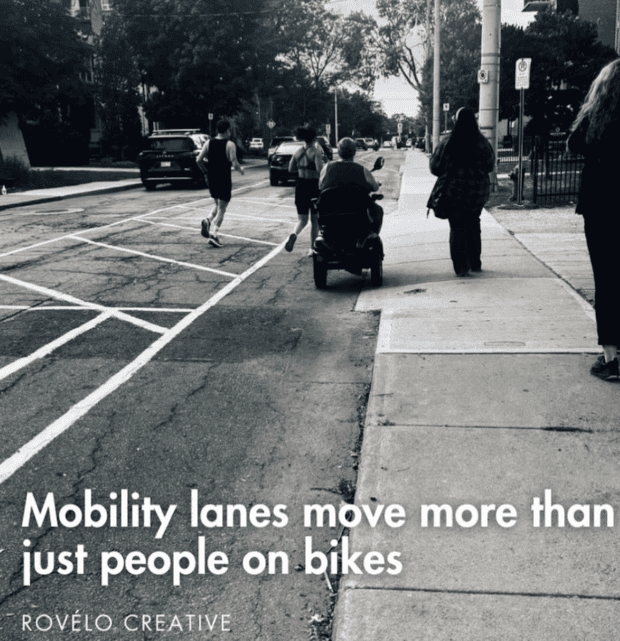
It’s not uncommon to see wheelchair users take advantage of the space and safety of the bike lane as well.
We recently learned that our friend Bernadette over in Brookline rides her mobility scooter in her neighborhood bike lane because it’s often easier than riding on the sidewalk. What’s interesting though, is that this “bike lane” is still an unofficial, unmarked shoulder, though utilized all the same. BikePGH is now working with Bernadette and other neighbors to advocate for an official marked bike lane on Broadway Ave in place of the current “phantom bike lane” in order to improve safety and clarity. Slam dunk for team work to get infrastructure benefiting everyone!
In Tom Flood’s words, bike lanes are more like mobility lanes
“Mobility lanes move more than just people on bikes and they often create much needed space that our minimal sidewalks lack.” – Rovelo Creative
But it’s the sad truth that most of our country’s roadways are built in ways that prioritize fast car travel over the safety of all road users. Related, many drivers tend to only think about getting to their destination as fast as humanly possible, while fiercely fighting against the safer road designs that could very well save their own family’s lives.
And unfortunately, there’s a real human cost to pay. Since 2010, pedestrian deaths have increased by 75% across the United States, and the problem will only intensify unless leaders choose to put the safety of people above all else. Then there’s still distractions, large vehicles, and driver behavior to consider, since even choosing to park on the sidewalk can put pedestrians at risk.

What’s more is that not everyone carries the same risk while walking: Black and Native Americans, older adults, and people walking in low-income communities die at higher rates and face higher levels of risk compared to all Americans (source: Smart Growth America). Additionally, according to PennDOT, “the greatest number of [bicycle] collisions and fatalities took place in an area with a high concentration of vulnerable populations.”
One possible reason for this is a historic lack of safe streets infrastructure investments. Lower-income communities also tend to lack sidewalks, painted crosswalks, and other traffic calming such as bike lanes, speed humps, and bump-outs for pedestrians.
That’s why it’s more important than ever to warmly welcome these types of safety improvements in our neighborhoods.
Sure, not every new project is an immediate home run in its initial form, and our landscape is not without its challenges. And of course, it’s important to work with neighbors who have critiques of new designs in the interest of coming to solutions that work for everyone. But when it comes to infrastructure upgrades that are meant to preserve the lives of our most vulnerable road users, we hope it becomes clear to folks that navigating your car around a few flex posts and actually driving the speed limit in places like Penn Ave in the Strip, is a benefit to the community and not a burden.
We have the right to respectfully engage: New street infrastructure isn’t threatening the vitality of our beloved city, it’s preventing a tragedy for another family
And for those disparaging “another nonsense design” that “looks like an obstacle course” and is “ruining” Pittsburgh? These street designs are intentional and proven to save lives. Just because it’s new and different doesn’t mean it’s random, and it’s certainly worth the investment to keep everyone safe (see also: data shows these efforts are working!)

With your help, we’re piecing together a more walkable, bikeable city, every day
When you donate, you’re supporting BikePGH as we work toward building a transportation network where all road users are respected, valued, and protected. Pittsburgh doesn’t become a safer and more connected city by chance. It happens because thousands of people like you step up to make change possible. BikePGH’s Year-End Campaign is our annual call to everyone who believes in making our city a place where biking and walking are safe and accessible for all.
 NEWSLETTER