
Building a safe and inclusive transportation network means centering the experiences of all road users, including those who navigate Pittsburgh without full sight
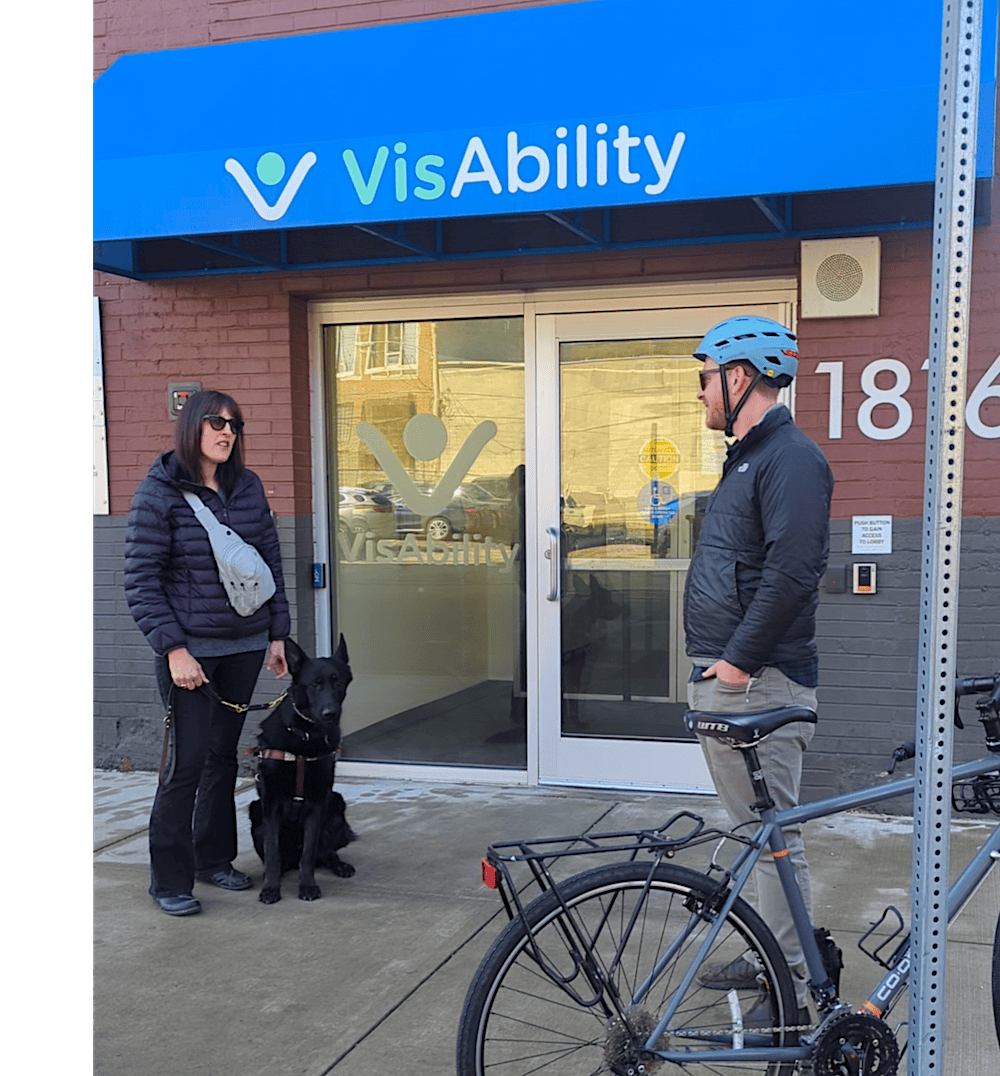
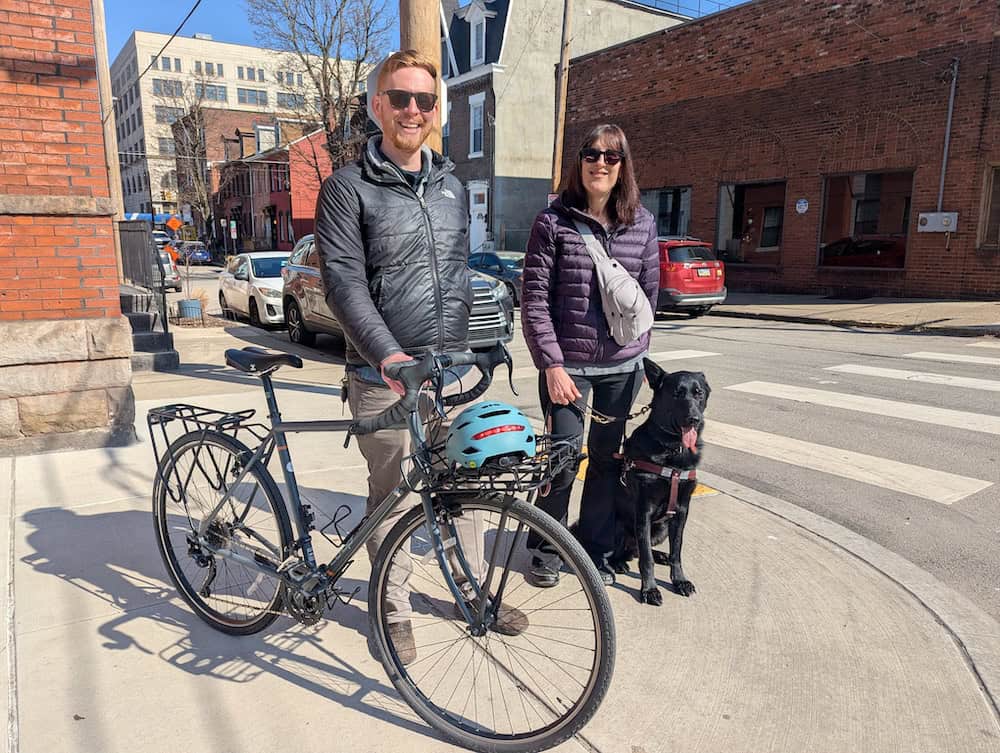
BikePGH Advocacy Manager Seth Bush recently sat down with Amelie Colletti, a Rehabilitation Specialist at VisAbility Pittsburgh. Amelie, who is an individual with low vision herself, shared her personal experience navigating the city with a white cane and a guide dog, offering crucial insights on how bicyclists and pedestrians can more safely and respectfully share space with people who are blind or have low vision.
Below is an edited version of their conversation. But first, the basics:
» Here Are Amelie’s Top Ways Cyclists and Pedestrians Can Make Streets Safer and more welcoming for the blind and low-vision community:
- Use Your Voice: A bell helps, but verbal cues are better. Slow down and say “Passing on your left” or “Passing on your right” before overtaking someone, whether or not you can tell if they can see you, even if you’re separated by a curb.
- Be Specific: Avoid vague warnings like “Watch out!” or “Over there.” Use specific directions like “There is a pole five feet to your left.”
- Respect the Right-of-Way: Sidewalks are for pedestrians first and foremost. Bicyclists should yield, slow down, or dismount.
- Take care after new construction: Be extra careful in areas where recent street changes have happened, because people and guidance systems may take time to adapt.
- Transit Etiquette: On the T, be ready to move your bikes away from priority seating and clear the space for people with disabilities or older riders.
- Don’t Touch Without Asking: Never grab, pull, or push someone to “help” them. Always ask, “Do you need help?” and wait for their response.
- Describe the Environment: When helping someone cross a street, describe the status of the light (e.g., “The light is red for traffic”) rather than simply saying “Go” or “It’s safe.”
- Take Care Around Everyone: Disabilities aren’t always noticeable. Slow down and take care anytime you are biking near someone walking, and assume any pedestrian may not see you.
» Background and Navigating the City
Amelie: My name is Amelie Colletti. I am an individual with a low vision condition that I have had since birth. […] My connection to the blind and low vision community is personal and professional. My family has the same genetic rod cone dystrophy condition. My father, my aunt, and my grandmother, we believe all had it. […] It’s a gene mutation. Which is progressive with age, so I have had a very gradual decline of my remaining vision. I only have vision in one eye. The other eye is approximately 20 over 1,000.
And I have been learning alongside friends and colleagues and clients about all the different technology available out there, and the different techniques that can be used to maintain independence. […] So, I’m still a work in progress, I’m still working on a lot of things, for myself, but a big passion for me is self-advocacy, and empowering others to do the same for themselves and for our community.
Seth: How has your vision changed over time, and how has that shaped the way that you navigate your neighborhood and the city at large?
Amelie: Similar to some of the other genetic retina conditions, the central and peripheral vision has changed, and my acuity and light sensitivity and night blindness have progressed with age. Now, I’m not 40 yet, but I hear in the 40 to 60 range is where that starts to deteriorate more rapidly. Because it’s so rare, we don’t know what the end of cone rod dystrophy will look like.
For me, it’s been learning the different tools and techniques so that I can keep moving forward and keep doing the things that I love. So, I’ve learned how to use a white cane. I was very stubborn about that until 3 years ago. And then I learned how to continue using public transportation, and walking the Pittsburgh neighborhoods using the white cane to navigate through obstacles and unsafe areas.
A big part of my coping strategy is memorization. My husband will tell you that I can take anybody around downtown Pittsburgh, Mount Washington, Station Square, Southside, Oakland.
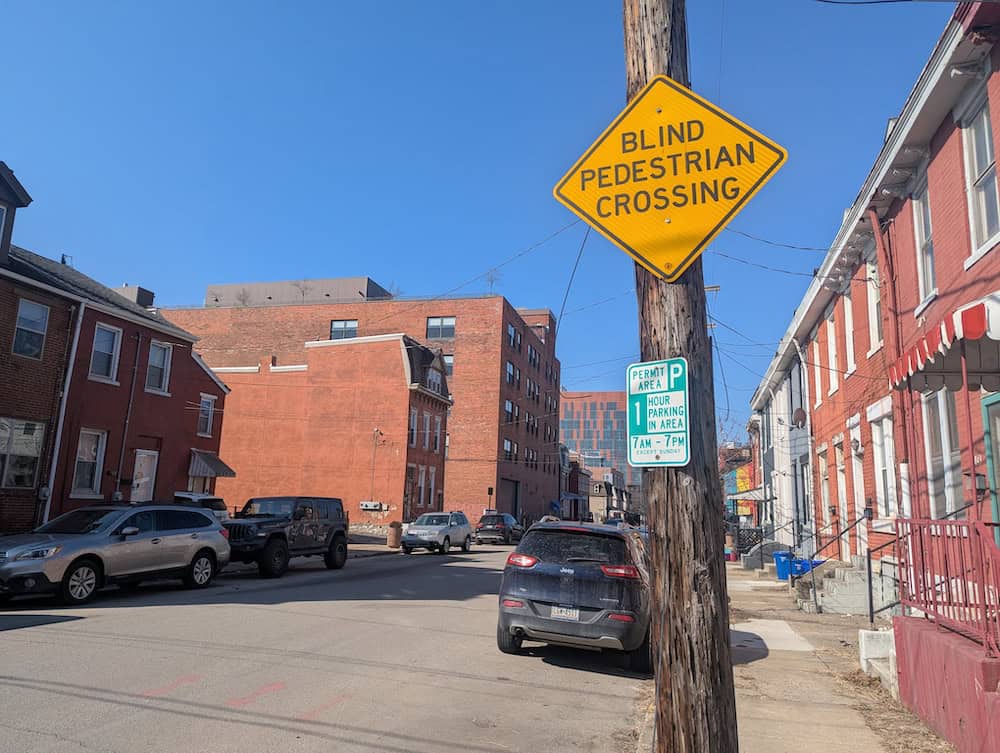
I can navigate those areas as a pedestrian better than anyone that is sighted sometimes, because I’ve just got this mental map in my head that I’ve developed over the years of living in Pittsburgh that I utilize every time, but it’s a lot of brain energy using that system.
And, you know, we have a lot of uneven sidewalks and construction areas. A lot of people are distracted. They’re looking at their phones, or they’re thinking about where they need to go, and so they’re not noticing someone who can’t see where they’re going.
So learning how to speak up for myself when I would get a little lost, or when I wasn’t sure if an area was safe, trying to turn to whoever I could if I could tell that somebody was around and could come to my aid. Those were, I think, the hardest things to adjust to, and I’m still working on that. There are some moments of pride where you just want to figure it out yourself and use the tools that you have, and not bother other people.
So that’s something that I think is really important for us to know as a community, that people do genuinely want to help us, but until we ask, they’re gonna assume we’re fine because we look like everybody else, for the most part.
Seth: When it comes to relying on memorization to get around, how do changes in the environment—like construction or new street layouts—affect your ability to move safely?
Amelie:…it can be frustrating.
I can remember a time where last winter, I came out of the side of Steel Plaza on 6th and 5th and I walked up towards the courthouse. I typically would go straight across Fifth Avenue at 6th, and then make a right, and walk alongside the courthouse toward Ross. Well, that morning, I crossed, and my dog stopped, and I was like – oh, I can’t go anywhere. There’s a mesh fence in front of me. And then I said to myself, okay, now what?
So I was like, okay, well, maybe I’ll just walk to work from here, because I can’t get to the bus stop. So then I turned and went left towards Lieberman Hall at the other corner, and I got across, and I was met by another barrier. And I had a little bit of a temper tantrum moment, where I was like, well, what am I supposed to do?
And so I had to basically make a full square back to the other side, and then I had to go through this really narrow space that they had left for pedestrians to walk along the side of BNY Building to get over to Ross Street. And then there was, like, mesh fencing on the other side. There was a new light fixture they put up next to another pole, and these are things that I have to mentally walk through because I’m not seeing it visually,
I’m blessed enough to have a guide dog, and so he’ll tell me where there’s unsafe places to navigate, but it’s a lot to handle when you’re trying to get to work on time.
It takes a lot more time to get from point A to point B.
Seth: It’s time, and also I imagine it really activates your nervous system…and then you have to start your workday stressed.
Amelie: Oh, absolutely. Because you’re worried that a car’s gonna hit you.
» Interactions with the Public and Infrastructure
Seth: You spoke about how blind people are sometimes not perceived, because it can be an invisible disability. And then I know you also have a guide dog, and you use a white cane. What is your experience when you do have those cues out to other people? How do other people interact with you?
Amelie: A white cane becomes an open door for people to be more civil with you, because they recognize that you might need more support.
Now, I will say that the reactions can be all over the map. I’ve had construction workers grab me and move me out of the way. Rather than saying, “hey, there’s an obstacle coming up. I can guide you around it, if you would like.”
So you’ll have both reactions. You’ll have people just spread out farther to give you more room, which is great, but at the same time then you feel like nobody’s around you.
Seth: How do changes in the environment, especially new bike lanes or street layouts, affect your ability to move safely?
Amelie: It definitely presents its challenges, especially when I don’t know where those will be in my path. Like, if I get to an intersection at Penn and 16th in the Strip District. I don’t know if there’s a bike lane there or not. That doesn’t come up on Google [when I’m planning my route], so when I go to cross those two lanes of traffic, I don’t have any sense of whether I should take into account if there’s gonna be a bicyclist that’s gonna come by me as I’m crossing. My dog should stop me if there’s any type of situation where he needs to disobey my command to go forward. He’s supposed to defy that and stop. It’s even harder when a bicyclist makes a fast turn around a corner where I’m crossing.
With a white cane, it absolutely is [a challenge], and the same thing with crossing bike lanes. With a cane, it’s all up to you and your judgment. When you have the guide dog, the guide dog helps you make some of those judgment calls. So he’ll go around all the obstacles, whereas my white cane’s gonna get caught in all of it.
Unexpected sidewalk closings are also a problem, and then other pedestrians and bicyclists and cars. Electric cars and bicycles have probably been one of the more challenging things, because you don’t hear them.
Seth: So that is a really important takeaway for bicyclists, especially when we’re moving faster. The tools you’re using digitally, like Google Maps or your own memorization, might not have caught up yet with new infrastructure you’re not expecting. That can take months. So we need to be extra careful in areas where things have changed in the past year or so.

» Biking Near Blind People
Seth: What are some situations where bicyclists or pedestrians may create safety risks for people who are blind or low vision?
Amelie: One of the things that I’ve noticed many sighted people do is try to be helpful by yelling directions from fairly far away, which can be very disorienting. Especially the direction is like, “hey, don’t step over there, there’s a hole.” That non-directional language can really mess us up because we have no idea where “over there” is. We need “to your left”, “to your right”, “about 5 feet to your left”. We need detail when you’re trying to communicate, especially when there’s a risk involved. Give us a direction and an amount of space as best you can.
The other thing that happens a lot is people just going by us silently, which can be disorienting and we could accidentally get bumped in another direction.
I think it’s also really important to realize that most white cane users today are using a pendulum swing, so they’re going left to right, very wide, out past their hip line. So, you may think that you are going to ride past and not be anywhere near, but we could potentially be in that left pendulum swing as you pass, which could cause an accident for you.
Seth: If a cyclist is passing or approaching a blind or low vision person, what is the best way to communicate?
Amelie: The more you can tell us, the more effective and safe will be for both of us, the bicyclist or the sighted pedestrian, and the blind or low vision individual that’s trying to navigate independently. Bikes that don’t have any sound when you’re riding up the road are a problem. If you could have some sort of bell or signal, like a beacon, so that we know that a bike is coming, that could be really effective.
And that should be followed by some sort of verbal communication a few moments before you pass, like, “going by on your left”,” going by on your right”. Something to just let that person know.
And slowing down as well.
Seth: Similarly, when I’m biking, and I hear a car horn, that can also be really disorienting to hear a loud noise without context, especially at fast speeds. So, I imagine the out-of-context bike bell is also confusing and not helpful.
Seth: What’s it like when cyclists speed past you in a bike lane that’s right next to the sidewalk, even if it’s separated?
Amelie: It’s a little scary to feel that whoosh go by you, and you’re like, “what in the world? I’m on the sidewalk, what is going by me right now?”
Seth: Absolutely, it’s the same thing that we get frustrated by when drivers close pass us when we’re biking.
Amelie: Yeah, that’s a great example of how it feels for us, I’m sure, what it feels like for a bike and a car going by real fast.
And the other concern that I have is the fact that we are not monitoring whether the lights are red, yellow, or green. We are only listening for traffic patterns. So if we are not hearing any vehicles for about a minute of time we’re gonna cross, because we’re gonna assume that the light is red, based on the traffic patterns. We have a way of knowing how long it takes us to cross a certain road. For me, it’s about 8 seconds. For someone else, it might be 20, depending on their ability level. So, if I’m at that point where I’m like, okay, there are no cars right now, it is safe to cross, and all of a sudden, a bike comes through the bike lane – I’m not gonna hear them until it’s almost too late.
So I think it would be great, and I know it’s not a perfect world, but if a bicyclist sees somebody with a white cane or a guide dog on the sidewalk even when they’re in the street, if they could just do those two things: make that bell cue, and say, “passing on your left”. That only takes 10 seconds.
And also, just being mindful that sidewalks are for pedestrians, not bicyclists, especially downtown. It’s not a way to cut out the traffic, because I’ve had that happen to me quite a few times. By the time I realized it was a bike, they were gone.
Seth: You also mentioned issues on the light rail (The T). Can you explain that?
Amelie: I’ve noticed quite a few times when I get on the trolley, the light rail, that a bicyclist will be there with their bike in the stowing area, which they are absolutely allowed to do when there’s not someone with a disability or a senior sitting in that stowing area. And then the bicyclist will be sitting in the first two seats, but sometimes they won’t announce themselves or explain to you what is in front of you. So I’ve gotten on the trolley, and I will tell my dog to find a seat, and he will go over to that area, but I don’t know the bicyclist is there. Then I’m feeling around to try to move the seat down so that we can sit, and I’m like, “oh, there’s something here. Oh, it’s a bike. Hey, you need to move, please.”
Just be aware, when you have your bicycle on the trolley that you may need to move to the back, and you are capable of moving to the back and knowing where you still are, whereas for someone who is blind or low vision, we may prefer to sit in those first couple seats, especially if we have a guide dog.
When there’s not as much room, and the further back we go, the harder it is for us to communicate with the operator and know where we are.
Seth: Are there any other cues besides a guide dog or white cane that a sighted person can use to notice somebody with no or low vision?
Amelie: I think every blind and low vision person looks different, so I don’t know that unless the person is open and willing to share it, you might be walking alongside or riding past someone who has very low vision. Until 3 years ago, I wasn’t using either of those. I was shuffling my feet to make sure I didn’t miss a curb or stairs. One other indicator could be if you see someone holding someone else’s elbow and walking slightly behind them, they’re using human guides, so don’t break those two people up.
But basically, assume pedestrians can’t see you. Be sure to alert them to your intentions and slow down.
» Offering Assistance Properly
Seth: What is the best way for someone to offer assistance to a person who is blind or has low vision in a public space?
Amelie: I generally prefer when someone just says, “do you need help?”
It can be as simple as that. Without assuming or deciding something on my behalf, making it a choice for me.
“Hey, I’m here. If you need help, let me know.”
It could even be like that. […]
It establishes that you have someone there that is willing and able. Then it’s my call, rather than you deciding it for me, and just saying, “here, I’m gonna take your arm and show you this seat.” Or, “I’m gonna take you and move you out of harm’s way”. That can cause a lot of other issues.
Seth: Sometimes people try to help by saying “It’s safe to cross.” Is that helpful?
Amelie: So, I’ve had people say you’re safe to cross. I don’t always respond to that. Only because there is human error.
I’ve had people insist on me crossing when the light was green, and they were like, oh, I’ll stand here, you’re safe, you’re good. And I’ll say, no, this is not the time to cross.
Seth: What language should we use instead?
Amelie: The light is right [red/green] or that the walk sign is on. That’s helpful information, which I can use to make my own choice about what’s safe for me.
Seth: Is there anything else people do, though well-intentioned, that isn’t helpful?
Amelie: I’ve had people grab and move me. And I prefer to be given verbal prompts or to follow a person. If somebody’s grabbing and moving me and manipulating me to get to somewhere, I’m never gonna remember where I went and how to get back. I need to do it myself to retain that information.
(this can just be the conclusion section)What final piece of advice would you give to bicyclists who want to be allies and advocates for accessibility and inclusion on our streets?
Amelie: I think it’s just keeping that line of communication open, and telling your fellow bicyclists how to engage with anyone with a disability.
I think we can all be better stewards, better humans, by just talking to each other, looking up, and giving someone the time – that little bit of energy that’s required to speak and engage.
And I think, too, getting involved. Get to know people that are blind or low vision. We have an amazing organization that is very active in the area called Blind Outdoor Leisure Development (BOLD). We tandem bike, and we always need captains who are sighted.
Many thanks to Amelie for talking with us!
Do you have another perspective to add, or more questions? Email us at advocacy@bikepgh.org to share your thoughts.
If you would like to listen to the full audio version of this interview, reach out to advocacy@bikepgh.org
 NEWSLETTER